The AI Agent Economy: Designing Products for Autonomous Workflows
In 2025, we're witnessing a fundamental shift in how software is consumed. For the first time, a significant portion of API calls, web requests, and product interactions aren't coming from humans—they're coming from AI agents. Tools like Claude Code, GitHub Copilot Workspace, and Devin are autonomously navigating products, consuming APIs, and completing tasks that previously required human oversight. This isn't a future trend; it's happening now, and it demands a complete rethinking of product design.
Product leaders who treat agents as "power users" or "another persona" are missing the point. Agents operate at fundamentally different speeds, scales, and failure modes than humans. They don't need beautiful UIs or progressive disclosure—they need robust APIs, clear error messages, and workflows designed for programmatic consumption. The products that win in the agent economy will be those designed from the ground up for autonomous operation.
Why Agent-First Design Matters Now
The numbers tell the story. According to recent data from API analytics platforms, agent-driven API traffic has grown 400% year-over-year at major developer platforms. GitHub reports that 46% of code commits now have AI involvement. Stripe's API usage from agents tripled in 2024. This isn't speculative—agents are already your users.
But here's the problem: most products weren't designed for agents. They were designed for humans clicking through UIs, reading documentation, and making judgment calls. When an agent encounters a vague error message, it doesn't debug—it fails. When it hits a rate limit, it doesn't pause thoughtfully—it retries exponentially. When it needs to complete a workflow, it doesn't intuit the next step—it follows your API schema literally.
The consequences of ignoring agent-first design are severe:
- Failed agent executions lead to customer churn (the agent vendor, not the end user, chooses which APIs to integrate)
- Poor error handling creates support nightmares (debugging agent failures is 10x harder than human failures)
- Rate limit misconfigurations cause infrastructure incidents (agents retry aggressively)
- Unclear API contracts result in brittle integrations that break with every release
The opportunity, however, is equally significant. Products designed for agents unlock entirely new markets, enable workflow automation at unprecedented scale, and create moats through superior developer experience.
The Agent Design Framework
After working with teams building agent-first products and observing successful agent integrations, I've identified four core principles for designing products in the agent economy:
1. API-First Architecture (Everything Must Be Programmable)
Agents can't click buttons. They can't interpret visual layouts. They need programmatic access to every feature, every workflow, and every piece of data. This sounds obvious, but most products fail this test.
What This Means in Practice:
- Complete API Coverage: Every feature in your UI must have an API equivalent. If users can create a document in the UI, agents must be able to create it via API. No exceptions.
- Consistent Response Formats: Use structured JSON responses, not HTML. Include machine-readable error codes, not just human-readable messages.
- Idempotency Keys: Agents will retry failed requests. Support idempotency to prevent duplicate operations.
- Webhooks Over Polling: Don't make agents poll for status updates. Send webhooks when operations complete.
Real-World Example:
Stripe's API is the gold standard here. Every operation—creating a customer, processing a payment, managing subscriptions—is API-first. Their error responses include structured error codes, suggested remediation steps, and links to documentation. When an agent encounters card_declined, it knows exactly what happened and how to handle it programmatically.
Contrast this with legacy payment processors that return HTTP 400 with an HTML error page. Agents can't parse that. The integration fails, and the agent vendor moves to a competitor.
Implementation Checklist:
- [ ] Every UI action has a corresponding API endpoint
- [ ] All responses use consistent JSON schemas with versioning
- [ ] Error responses include machine-readable codes and suggested actions
- [ ] Idempotency is supported for all state-changing operations
- [ ] Webhooks are available for long-running operations

Figure 1: Agent-first API workflow demonstrating idempotency keys, explicit rate limits, async webhooks, and request ID propagation. This pattern ensures agents can safely retry operations, understand rate limits, avoid polling, and enable debugging through traceable request IDs.
2. Explicit Contracts Over Implicit Behavior
Humans can handle ambiguity. Agents cannot. When your API documentation says "usually returns within 5 seconds," an agent doesn't know what to do. When your rate limit is "approximately 100 requests per minute," an agent will either under-utilize or over-trigger limits.
What This Means in Practice:
- Strict API Schemas: Use OpenAPI/Swagger specifications with strict validation. Every field should have explicit types, constraints, and examples.
- Versioned Contracts: Never change behavior without versioning. Agents depend on exact behavior—breaking changes break agents.
- Explicit Rate Limits: Return rate limit headers (
X-RateLimit-Limit, X-RateLimit-Remaining, X-RateLimit-Reset) on every response. - Documented SLAs: Publish latency percentiles, uptime targets, and timeout recommendations. Agents need to set their own timeouts appropriately.
Real-World Example:
Anthropic's API includes explicit rate limits in headers, versioned API paths (/v1/messages), and detailed JSON schemas for every request and response. When Claude Code calls the API, it knows exactly how many requests it can make, when limits reset, and what structure to expect.
Compare this to APIs that silently throttle or return different response structures based on load. Agents can't adapt to that—they just fail.
Implementation Checklist:
- [ ] OpenAPI/Swagger specs published and kept up-to-date
- [ ] All endpoints include rate limit headers
- [ ] API versioning strategy defined and documented
- [ ] Timeout recommendations published for every endpoint
- [ ] Breaking changes require new API versions
3. Graceful Degradation and Recovery
Agents operate at scale. They'll hit edge cases, encounter partial failures, and need to recover from errors—all without human intervention. Your product must be designed for this reality.
What This Means in Practice:
- Partial Success Support: Allow agents to batch operations and handle partial failures. If 10 items are uploaded and 2 fail, return success for 8 and specific errors for 2.
- Retry Guidance: Include
Retry-After headers when rate limited. Specify which errors are retryable (503 Service Unavailable) vs. permanent (400 Bad Request). - Transactional Operations: Provide atomic operations where all-or-nothing behavior is critical. Agents shouldn't have to implement their own rollback logic.
- Status Endpoints: Offer endpoints to query operation status. If an agent loses connection mid-upload, it should be able to check "did this complete?"
Real-World Example:
GitHub's API handles batch operations elegantly. When creating multiple issues via API, it returns HTTP 207 Multi-Status with individual success/failure codes for each item. Agents can parse this and know exactly which operations succeeded and which need to be retried.
Implementation Checklist:
- [ ] Batch endpoints return granular success/failure status
- [ ] Retryable errors include
Retry-After headers - [ ] Status query endpoints exist for long-running operations
- [ ] Transactional operations are atomic or clearly documented as non-atomic
- [ ] Error codes distinguish between client errors (4xx) and server errors (5xx)
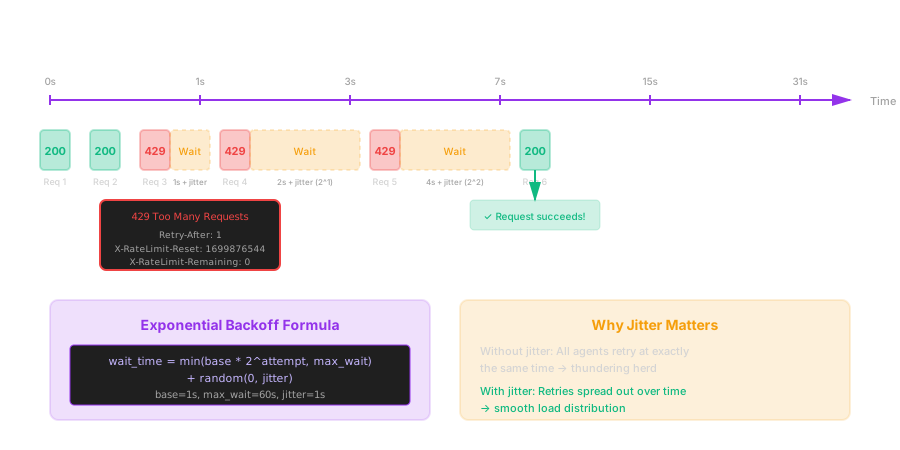
Figure 2: Rate limiting with exponential backoff and jitter. When agents hit 429 errors, they should implement exponential backoff (1s, 2s, 4s, 8s...) with random jitter to prevent thundering herd problems. The Retry-After header tells agents exactly when to retry.
4. Observable and Debuggable
When an agent fails, debugging is exponentially harder than debugging human failures. Humans can tell you what they clicked and what they saw. Agents just error out. Your product must provide the observability agents and their developers need.
What This Means in Practice:
- Request IDs: Include a unique request ID in every response. When agents report failures, engineers can trace the exact request.
- Structured Logging: Log agent interactions with context (agent identity, request parameters, response codes). Make these logs searchable.
- Detailed Error Messages: Don't return "Bad Request." Return "Missing required field: customer.email. Expected format: string, valid email address."
- API Usage Dashboards: Provide dashboards showing API usage, error rates, and latency per endpoint. Agent developers need to monitor their integrations.
Real-World Example:
AWS includes a x-amzn-RequestId header in every API response. When something goes wrong, you can provide that ID to support, and they can trace the exact request through their systems. This is essential for debugging agent failures where you don't have a human to interview.
Implementation Checklist:
- [ ] Every API response includes a unique request ID
- [ ] Error messages include specific field-level validation failures
- [ ] API usage dashboard available to developers
- [ ] Structured logs capture agent identity and request context
- [ ] Documentation includes example error responses with explanations
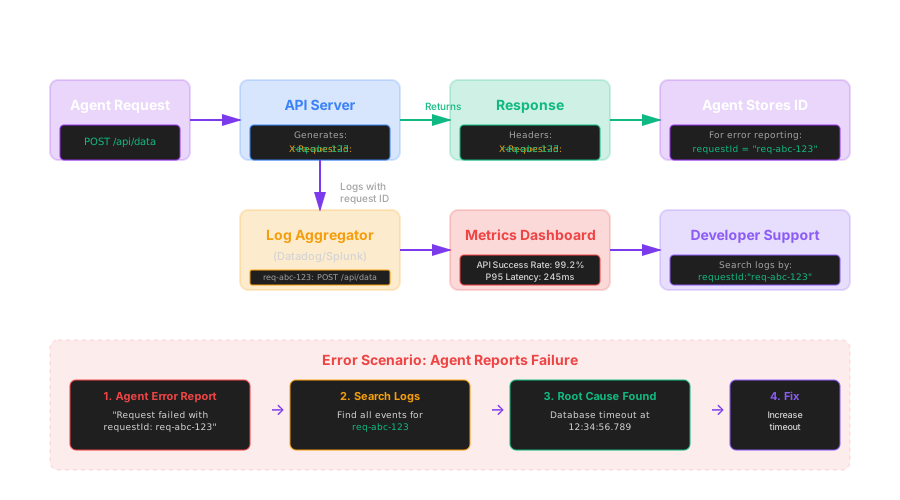
Figure 3: Agent observability pipeline with request ID propagation. Every API response includes a unique X-Request-Id that flows through logs, metrics dashboards, and support systems. When an agent reports a failure, engineers can trace the exact request through the entire system to identify root causes.
Designing Workflows for Agent Execution
Beyond API design, workflows themselves must be rethought for agent consumption. Agents don't navigate UIs or read between the lines—they execute steps programmatically.
Linear Workflows Over Branching UIs
Human UIs use progressive disclosure: show a few options, then reveal more based on selections. Agents need the entire workflow exposed upfront.
Design Pattern:
Instead of: 1. GET /products → Show UI with filters 2. User selects filters → GET /products?category=X 3. User clicks product → GET /products/:id 4. User clicks "add to cart" → POST /cart
Design for agents: 1. GET /products/schema → Returns available filters, sort options, pagination 2. GET /products?category=X&limit=50 → Returns products with full data 3. POST /cart/items → Accepts product ID, quantity, and optional parameters in one call
Agents can now execute the workflow in 2-3 API calls instead of 4+, with no ambiguity about what's possible.
Stateless Over Stateful
Agents lose state. They get interrupted, restarted, and run in parallel. Design workflows that don't depend on session state or sequential operations unless absolutely necessary.
Design Pattern:
Bad: Sessions that expire after 30 minutes of inactivity Good: Long-lived API tokens with explicit refresh logic
Bad: Multi-step checkout that requires maintaining cart state server-side Good: Idempotent checkout endpoint that accepts full order details in one call
Metrics for Agent Success
Traditional product metrics (DAU, session duration, conversion rates) don't apply to agents. You need new metrics:
Agent-Specific Metrics:
- API Success Rate: % of API calls that return 2xx vs. 4xx/5xx
- P95 Latency: Agents set timeouts based on worst-case latency, not average
- Error Recovery Rate: % of failed operations that succeed on retry
- Integration Stability: API breaking changes per month (target: zero)
- Agent Adoption: % of API traffic from known agent user-agents
Business Metrics:
- Agent-Driven Revenue: Revenue from users acquired via agent workflows
- Developer Retention: % of developers maintaining active agent integrations
- Agent NPS: Survey agent developers, not end users
Pricing Models for the Agent Economy
Traditional SaaS pricing (per-seat, per-user) doesn't work for agents. An agent might complete 1,000 tasks in an hour—that's not "one user."
Successful Pricing Models:
1. Usage-Based: Stripe's model—pay per API call, per transaction, per resource consumed 2. Compute-Based: Anthropic's model—pay per token, per model call, with volume discounts 3. Outcome-Based: Pay per completed task, per successful workflow, per result delivered
The key: pricing must align with agent value delivery, not human usage patterns.
Real-World Success Stories
Zapier: Rebuilt their platform for agent-first automation. Every app integration is programmatic, every workflow is reproducible, every error is machine-parseable. Result: 7M+ automated workflows, 600+ apps integrated.
Linear: Designed their issue tracker with a robust GraphQL API from day one. Agents can create issues, update statuses, and query data without touching the UI. Result: 40% of issue creation happens via API, primarily from agents and automation tools.
Vercel: Built their deployment platform as API-first. Agents can deploy, rollback, and manage infrastructure programmatically. Result: 80% of deployments are triggered via API or CLI (agent-driven), not the web UI.
What This Means for Product Leaders
If you're building a product that could be consumed by agents (and that's almost every B2B product), you need to:
1. Audit API Coverage: Can every feature be accessed programmatically? If not, prioritize API parity. 2. Instrument Agent Traffic: Start measuring agent vs. human usage. Understand which workflows agents prefer. 3. Talk to Agent Developers: The developers building agents for your platform are now your key customers. Interview them. 4. Redesign for Observability: Add request IDs, improve error messages, build usage dashboards. 5. Commit to API Stability: Treat API breaking changes like data loss incidents—they break agent workflows at scale.
The Future is Autonomous
The products that win in the next decade won't just tolerate agent usage—they'll be designed for it from the ground up. APIs will be the primary interface, not an afterthought. Error handling will be robust enough for autonomous systems. Pricing will align with value delivered, not seats filled.
This isn't about choosing between human users and agents. It's about designing products that serve both, recognizing that agents are becoming the primary way humans interact with software. The teams that understand this will build the infrastructure layer of the agent economy. The teams that don't will find their products bypassed in favor of agent-friendly alternatives.
The agent economy is here. The question is: are your products ready for it?