The Future of AI-Powered Code Reviews
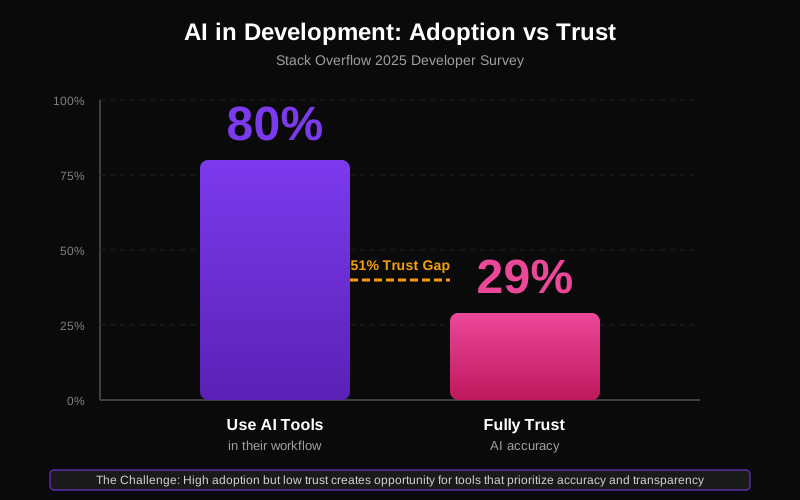
Code review has long been one of the most valuable yet time-consuming practices in software development. As AI capabilities advance, we're witnessing a fundamental transformation in how teams approach code quality, knowledge sharing, and collaborative development. According to Stack Overflow's 2025 Developer Survey, 80% of developers now use AI tools in their workflow—though interestingly, only 29% fully trust their accuracy. This tension between adoption and trust defines the current state of AI-assisted code review.
The Current State and Market Growth
Traditional code review processes face several persistent challenges. Reviewers must context-switch between their own work and reviewing others' code, often leading to delays and shallow reviews. Teams struggle to maintain consistent standards across reviewers, and junior developers may not receive the detailed feedback they need to grow. Meanwhile, senior engineers spend significant time on mechanical issues that could be automated.
The market recognizes this opportunity. According to Cognitive Market Research, the global code review market was valued at $784.5 million in 2021 and is projected to reach $1,028 million by the end of 2025—a clear signal that organizations are investing heavily in improving their review processes.
The most effective code reviews I've participated in combined multiple perspectives: catching bugs, ensuring code quality, verifying architectural alignment, and facilitating knowledge transfer. But achieving all these goals consistently requires significant time investment that many teams can't sustain.
AI as a Force Multiplier
Modern AI systems can analyze code with a depth and consistency that complements human review. Research published on arXiv examining AI code review effectiveness shows that these tools excel at pattern recognition, can instantly recall best practices from millions of code examples, and never get tired or distracted. More importantly, they can provide immediate feedback, reducing the feedback loop from hours or days to seconds.
Recent industry analysis reveals that 63% of professional developers currently use AI in their development process, with projections suggesting this could grow 4x by 2026. This rapid adoption reflects the tangible benefits teams are experiencing.
Automated Quality Checks
AI-powered tools like GitHub Copilot, CodeRabbit, and Qodo Merge can catch issues that traditionally required human attention:
- Subtle bug patterns that static analysis tools miss, like race conditions or edge cases in complex logic
- Performance implications of specific code patterns, including memory leaks and inefficient algorithms
- Security vulnerabilities beyond basic pattern matching, understanding context and data flow
- Accessibility issues in frontend code that might not be caught by linters
These automated checks don't just flag problems—they explain why something is an issue and suggest specific fixes, turning every code review into a learning opportunity. Tools like Sourcery and Codacy have demonstrated that AI can reduce review time by 30-50% while maintaining or improving code quality.
Architectural Consistency
One of the most valuable aspects of code review is ensuring new code aligns with existing architecture. AI systems can learn a codebase's patterns and conventions, then flag deviations:
- Identifying when new code duplicates existing functionality
- Suggesting existing utilities or patterns that should be used
- Detecting architectural violations before they become technical debt
- Recommending refactoring opportunities to improve consistency
CodeScene, for example, uses AI to analyze not just individual changes but the evolution of your codebase over time, identifying hotspots and technical debt patterns that human reviewers might miss.
This is particularly valuable for large codebases where no single person understands every component. The AI becomes a guardian of architectural principles, ensuring consistency even as teams scale.
Practical Implementation
I've been experimenting with AI-powered code review in several projects, and the results have been illuminating. The key is integration that feels natural rather than intrusive.
The Review Workflow
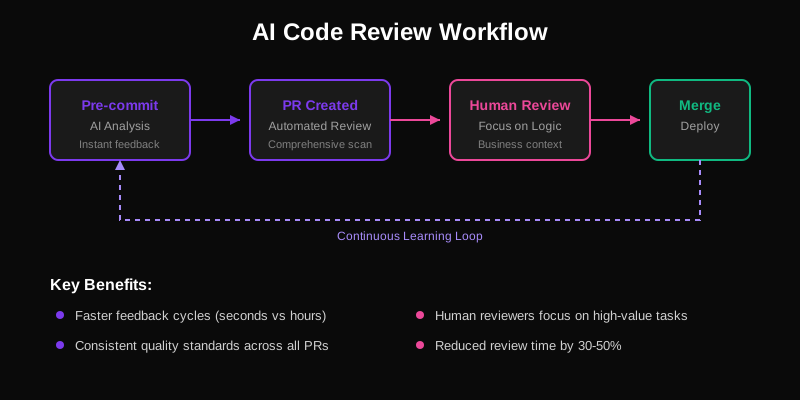
The most effective workflow I've found combines AI and human review in stages:
1. Pre-commit AI analysis: Developers get immediate feedback as they write code, catching obvious issues before committing 2. Automated PR review: When a pull request is opened, AI provides comprehensive analysis within seconds 3. Human review focus: With mechanical issues handled, human reviewers focus on business logic, user experience, and architectural decisions 4. Continuous learning: The AI learns from human reviewer feedback, improving its suggestions over time
This staged approach means developers get faster feedback while human reviewers can focus on areas where their expertise adds the most value. Research shows that teams that adopt this hybrid approach report higher satisfaction with the review process overall.
Context-Aware Suggestions
The most impressive AI code review systems understand context beyond individual files. Modern tools like Sourcegraph Cody and Greptile can:
- Analyze how changes affect dependent code across the entire codebase
- Suggest test cases based on the specific changes and existing test patterns
- Identify potential breaking changes by understanding API contracts
- Recommend documentation updates when public interfaces change
This holistic understanding transforms code review from a file-by-file process to a system-wide analysis.
The Human Element
Despite AI's capabilities, human judgment remains essential. AI can identify potential issues, but humans must decide which issues matter in context. A technically suboptimal solution might be the right choice given time constraints or specific requirements.
What Humans Do Best
Human reviewers excel at:
- Understanding business context: Does this code solve the right problem?
- Evaluating trade-offs: Is this the right balance of complexity vs. functionality?
- Mentoring and knowledge sharing: Explaining not just what to change, but why
- Considering user impact: How will this affect the user experience?
The future of code review isn't AI replacing humans—it's AI handling mechanical analysis so humans can focus on these higher-level concerns. PullRequest, for instance, combines AI analysis with expert human reviewers, recognizing that both perspectives are valuable.
Challenges and Considerations
Implementing AI-powered code review isn't without challenges. Teams must consider:
Trust and Adoption
The Stack Overflow survey data showing only 29% of developers fully trust AI accuracy highlights a critical challenge. Developers need to trust AI suggestions before they'll act on them. This requires:
- High accuracy to avoid false positives that waste time
- Clear explanations for why something is flagged
- Easy ways to provide feedback when AI is wrong
- Gradual rollout to build confidence
Privacy and Security
Code review AI systems need access to your codebase, raising important questions:
- How is code data stored and processed?
- What happens to proprietary code and algorithms?
- Can the system be run entirely on-premises for sensitive projects?
- How do you prevent AI from learning and suggesting proprietary patterns to other users?
Many tools address these concerns by offering self-hosted options or "bring your own key" (BYOK) models for enhanced privacy control.
Integration Complexity
Effective AI code review requires integration with existing tools:
- Version control systems (GitHub, GitLab, Bitbucket, Azure DevOps)
- CI/CD pipelines for automated checks
- IDE integration for real-time feedback
- Team communication tools for notifications
The best systems integrate seamlessly into existing workflows rather than requiring teams to adopt new tools.
Looking Forward
The next generation of AI code review tools will be even more sophisticated. We're moving toward systems that:
- Understand intent: Analyzing not just what code does, but what it's trying to accomplish
- Suggest improvements: Proactively recommending refactoring and optimization opportunities
- Learn team preferences: Adapting to each team's specific standards and priorities
- Facilitate collaboration: Helping teams share knowledge and maintain consistency
Some emerging capabilities are particularly exciting:
Automated Refactoring
AI systems that can not only identify code smells but automatically refactor code while preserving behavior. Several tools are pioneering this space, offering one-click refactoring suggestions that maintain test coverage.
Intelligent Test Generation
AI that analyzes code changes and automatically generates comprehensive test cases, including edge cases that humans might miss. This could dramatically improve test coverage while reducing the time developers spend writing tests.
Cross-Repository Learning
Systems that learn from multiple codebases, identifying best practices and anti-patterns across the industry. This collective intelligence could help teams avoid common pitfalls and adopt proven patterns.
The Emerging Landscape
The AI code review tool ecosystem has exploded in 2024-2025. Beyond the major players, innovative tools are emerging:
- Bito focuses on onboarding acceleration with AI-generated PR summaries
- Traycer offers task-based analysis for complex changes
- Sweep AI provides JetBrains-native AI assistance
Each tool brings unique strengths, and the competition is driving rapid innovation across the space.
Practical Recommendations
For teams looking to adopt AI-powered code review:
1. Start small: Begin with automated quality checks before moving to more complex analysis 2. Measure impact: Track metrics like review time, bug detection rate, and developer satisfaction 3. Iterate based on feedback: Regularly gather input from developers and adjust configurations 4. Maintain human oversight: Use AI to augment, not replace, human review 5. Invest in integration: Ensure AI tools fit naturally into existing workflows 6. Address trust concerns: Be transparent about AI limitations and provide clear explanations for suggestions
The Bottom Line
The data tells a compelling story: AI code review tools are being rapidly adopted, the market is growing significantly, and teams are seeing real benefits. However, the trust gap remains a challenge that tool builders must address through transparency, accuracy, and clear communication.
The teams that successfully adopt AI code review will have a significant advantage: faster development cycles, higher code quality, and more time for innovation. The future of software development isn't about choosing between human expertise and AI capabilities—it's about combining both to build better software, faster.
As we move forward, the question isn't whether to adopt AI code review, but how to do so thoughtfully, maintaining the human judgment and context that makes code review valuable while leveraging AI's speed and consistency. The tools are here, the market is growing, and the early adopters are already seeing results. The future of code review is collaborative—human and AI working together.